
5 Bucket-List Moments on a Zambezi Multi-Day Rafting Trip
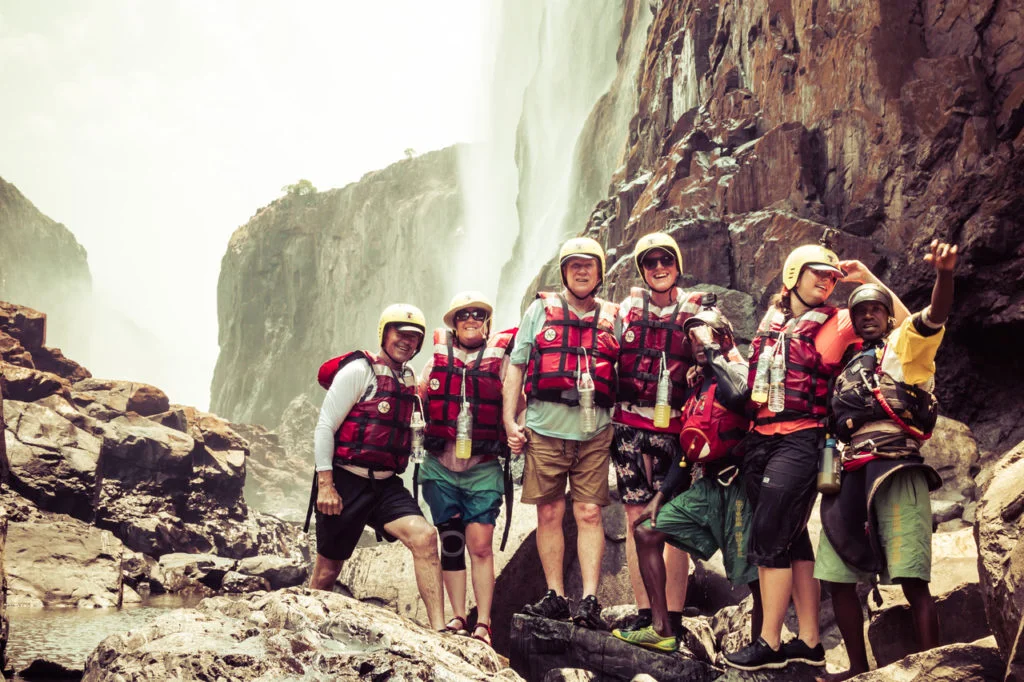
1. Having lunch UNDER Victoria Falls The view is quite literally jaw-dropping. Your very first lunch on the multi-day rafting trip is served under Victoria Falls – as you sit and eat, the spray cools your back. Look up to see one of the world’s natural wonders in her full glory and hear the squeals of bungee jumpers as they leap off Victoria Falls Bridge. If you fancy a swim, there is a beautifully still pool just metres away where you can cool off. This part of Victoria Falls is only accessible with a professional guide and not many get to munch lunch here. Lunch with a view – below the mighty Falls 2.Shooting the Rapids Paddling down the Zambezi may be tiring, but the adrenaline fuels you on. As you approach a rapid you start to feel the butterflies in your stomach, the horizon of the rapid appears and below you, you can hear the water roaring like a hungry beast. The Zambezi is alive, powerful and demands the utmost respect. Witness the water painting the rocks, shaping and moulding them into ever-changing artworks. Considered one of the best stretches of commercially run river in the world, Batoka Gorge provides one of the most intense sensory thrills imaginable. Its 25 white-water rapids and striking scenery deep within the sheer black cliffs afford the adrenaline junkie a wild roller-coaster ride along a route carved over millennia by the Great Zambezi. As your guide expertly reads the river and chooses a line into the surging, racing rapid – hold on tight for the ride of a lifetime. Bobbing about, water flying everywhere, people laughing and screaming, boats flipping and paddlers swimming. And then it’s all calm again. That’s the beauty of the Zambezi. Shooting down the rapids 3. Sleeping under the African Stars There is always the option to sleep in a tent, but I opted for white sands and an African starlit sky. Being down in the Batoka Gorge means there is no light pollution, so the stars appear extra vivid and bright… it’s totally mesmerising. There is something special about stars and a fire – and it doesn’t take long before my fellow raft crew start recounting incredible stories and life experiences. There is nothing quite like an African folk tale or travellers story to put all the bushbabies to sleep. To top it off when the morning arrives, you slowly emerge to a glorious auburn sunrise as it creeps along the river softly nudging the gorge and its sleepy inhabitants awake. Camp set-up above rapid no. 10 4. Seeing Moemba Falls On the third and final night you are treated to a smorgasbord of treats just above Moemba Falls, the song of the thundering water serenading you as your lips touch your ice-cold gin and tonic and your eyes peer into the sunset. This view can only be accessed by raft, making it that much more special – only a select handful of people can say they have witnessed the might of the Moemba Falls. Enjoying a cold-one above Moemba Falls 5. Disconnect in order to reconnect For many, the true treasure of a Safpar multi-day rafting trip is the total isolation and separation from our fast-paced lives and the exploration of our natural world. There’s no news, emails or cellphones out here. Here you engage with your crew, your surroundings and with yourself. Soak it up, soak it in. The rarity of being provided the space to escape is a unique privilege and I highly recommend a visit to this modern-day Narnia. Rafts parked for the night at rapid no.10 BOOK A TRIP : Safari Par Excellence (SAFPAR) have been rafting the Mighty Zambezi since 1988! The passion, experience and culture of their rafting team is second to none. Safpar is currently the only company on the Zambezi with a 100% guide certification under the International Rafting Federation. All guides are fully trained professionals and hold valid advanced first aid certificates. Safpar offer both Full Day, Overnight and Multi-Day Rafting Trips. www.safpar.com
Zambezi Canoeing, “Mosi-oa-Tunya” Park, Livingstone Victoria Falls Safpar.

Victoria Falls, the first tourist. In 1855, on November the 17th (or thereabouts, the actual day is contested), Dr. David Livingstone departed “Kalai” island on the Zambezi River and headed off to view what the local Makololo people called, “Mosi-oa-tunya”. Or as translated today “the smoke that thunders”. In true keeping with the staid, stiff-lipped, Victorian pioneering spirit, prevalent at the time. The good doctor notes he kept a brave face, and a level head, on the no doubt, hair rising approach up to what is today known as Livingstone Island. Absolutely determined that he could endure whatever his local,”mokoro” (a wooden canoe made from a single tree trunk), paddling guides could. It is interesting to note that Livingstone’s companion Chief Sekulute, of the Makololo people, did not accompany him on this short foray to the edge of the 105m chasm. Which Livingstone, later christened “Victoria Falls”, after his beloved monarch. According to Livingstone, on the morning of departure for the falls, the second manned canoe the chief had ordered up for the trip failed to arrive. Whereupon the chief solicitously let David, who was arguably the regions very first tourist, carry on alone with his guides. From this humble canoe beginning over a hundred and fifty years ago. We now have a plethora of daily boat and foot expeditions, to the very spot where Dr. David Livingstone first lay enraptured, staring down into the falls. Allegedly uttering the phrase “a sight so wonderful that Angels must have gazed down on it in flight”. The Mosi-oa-Tunya National Park on the Zambezi River. While the name “Victoria Falls” and “Mosi-oa-tunya”, are widely accepted as the name of the Seventh natural wonder of the world. The description of the Makololo people of the rising mist “Mosi-oa-tunya”, directly translated as the “smoke that sounds”, is also the name of Zambia’s smallest national park. At just sixty-six square kilometers, the “Mosi-oa-Tunya” national park also includes twelve kilometers of pristine Zambezi river frontage. Stretching up to the Sinde river mouth and including the falls themselves. While demand for following the footsteps of Dr. David Livingstone onto “Livingstone Island” and the sights thereon, has grown exponentially over the past years. The upper reaches of his journey, up to and including “Kalia” island have not been offered to the same extent, until now. Safari-par-Excellence canoeing trips. From the 1st of April 2018, Safari-Par Excellence has begun offering canoe trips into the Mosi-oa-Tunya national park. In an area arguably in much the same condition as that which Dr. David Livingstone, Chief Sekulute, and his two-hundred Makolole retainers would have found it. While following in the paddle strokes of the acclaimed explorer and his companions, the expedition style trips on the Zambezi River also offer the modern day adventurer some superb game viewing opportunities. In the dry season, the small Mosi-oa-Tunya national park has been known to have up to three hundred elephants at any one time within its borders. The park is also home to large populations of hippopotamus and Nile Crocodile, which are seen on most trips. While the park itself is not home to the big African cats, it has a wide range of wildlife easily seen from the river, these include among others, Buffalo, waterbuck, bushbuck, warthog, foraging baboons, Nile monitor lizards and a huge variety of birdlife. The Mosi-oa-Tunya park is also synonymous with sightings of large family groups of Giraffes. Famous recent descents of the Zambezi. Perhaps one of the most recent, famous descents of this section of the Zambezi River. Has to be that of the team from “Comic Relief” in 2013, where celebrities Mel C, Jack Dee, Dara O’Briain, Greg James, Chelsee Healey and Phillips Idowu took on the mighty Zambezi River expedition in the name of charity. The group was under the instruction of Safari-Par-Excellence’s River manager Andrew “Sven” Bolton. Raising over 570,000 GBP for good causes the world over. One of the schools close to the canoe “put-in”,”Mundia school” is still sponsored by this event. Safari-par-excellence still contributes greatly to the school through various fundraising activities. While the canoeing trips on the Zambezi are of a much more luxurious, relaxed nature, than that done by the red nose celebrities. The transition to using the park’s river frontage as a resource is also vital to the survival of the park. Conservation in practice. The Mosi-oa-Tunya national park is administered and run by the Zambian Department of National Parks and Wildlife. The entry fees, park usage, and river usage all guests indirectly and directly pay. Are vital to the continued existence of the countries wild places and the Mosi-oa-Tunya National park in particular. The park is also home to the majority of the countries endangered white Rhino population, the contribution of low impact sustainable tourism cannot be understated. Safari-Par-Excellence already operates the “The Elephant Cafe’” in the Mosi-oa-Tunya national park and the Cafe’s rescue herd of ten elephants live within the park on the banks of the river. References: David Livingstone(1873).MISSIONARY TRAVELS AND RESEARCHES IN SOUTH AFRICA. Urbana, Illinois: Project Gutenberg. Retrieved April 04, 2018, from www.gutenberg.org[EBook #1039]. Image Credits Images © National Library of Scotland. Creative Commons Share-alike 2.5 UK: Scotland https://creativecommons.org/licenses/by-nc-sa/2.5/scotland
Top 5 Livingstone Victoria Falls travel tips.

1) Know your Visa requirements If you are not from the SADC region and require a Visa when visiting Zambia, and the Victoria Falls, there are a few options you should be aware of depending on your itinerary. Those passport holders who qualify to purchase a visa at the port of entry have the option of a “Single entry Visa” for USD 50, a “KAZA Visa” for USD 50 or a “multiple entry Visa for USD 80. Generally speaking, the best option is the “KAZA Visa”. This allows multiple-entry travel between Zimbabwe and Zambia and a day trip to Botswana and is valid for a month. It is important you specifically ask for the “KAZA Visa” at the port of entry. Additionally, be sure to check the number of days you have been given in your passport and that of any dependents. Overstaying is a serious problem and can be easily avoided by checking the number of days before leaving the desk. Some of the entry ports can take payment by card, but this can be hit and miss. Aim to have the right cash amount on hand for your party; in the correct denominations. Check if you are eligible for a KAZA Visa on arrival here. Some nationalities will be required to apply for a visa in advance of travel to Zambia – if you are one of those passport holders who want to do more than a day-trip to Zimbabwe or Botswana. Tt would be best to apply for a multiple-entry Zambian Visa at USD 80 pp. (Please check in advance whether you need to pre-apply for a visa to your day-trip country too!) Check if you require a visa in advance of travel to Zambia here. Addendum: Please be advised that if you are NOT from one of these countries you will need to apply for a Visa for Botswana regardless of having the KAZA visa. 2) Book in advance Some activities that the region is famous for, have limited space and you could be disappointed during peak season. Be sure to book “The Elephant Café”, the microlight “Flight of the Angels” and “Devil’s Pool” in advance. Other iconic activities such as the “Whitewater rafting” and the “River cruises” can usually be booked while in the region. However, early booking confirmation allows you to make the most of your time without having to shuffle things around. 3) Plan your “Falls Day” Prior planning for your visit to “Mosi-Oa-Tunya” (the “Smoke that Thunders”) as “Victoria Falls” is locally known is important. Travelers often get carried away with everything the region has to offer. Often ending up rushing the falls in a morning before they fly out. A good way to do the “Victoria Falls” is to plan your visit around the “Devil’s pool” or the “Micro-light flight”. Both of these activities can take place early in the morning or late in the afternoon and augment a “Day of Thunder”. You can see the waterfall from these incredible vantage points and then enter the park on foot. Also be aware that around the full moon during high water, the park is open for guests to view the “moonbows”, nighttime rainbows. The cost to enter the park for this is an additional USD 30, take a small picnic and a bottle of wine; be courteous with your flashlight, you don’t need to put it on, the moon provides plenty of light. Start off with visiting the Victoria Falls from the Zambian side, entry for international visitors is USD 20 per person. Depending on the time of year, allow an hour and thirty minutes for the walk around the viewing points. If you are physically fit it is worthwhile to hike into the “boiling pot”. This is where you can view the historic Victoria Falls Bridge and the Batoka Gorge just below the face of the falls. Ask for directions from the National Heritage staff on-site. This is particularly worthwhile during the high water season from February-June. Allow an extra forty-five minutes for this and make sure you take drinking water with you. From the Zambian Falls gate, the Zambian Exit border is a short walk away. Once you have stamped out of Zambia you can easily walk to the Zimbabwean border, this is worthwhile as you can walk across the Victoria Falls bridge, which offers some great viewing opportunities. There are taxi’s, usually charging about USD 3 per taxi if you would rather not tackle the 1.3km walk. On the way across the bridge, you can stop at the “Bridge Café” for a beer or refreshment. From here you have a great view of the bridge and the bungee jumpers. As you stamp into Zimbabwe the entrance to the Victoria Falls is a 100 meters from the border. The Entry Fee is USD 30 per person for International Residents and USD 20 for SADC Residents. Allow for 2 hours to view the falls from this side. Once this is done, a “High Tea” at the colonial era “Victoria Falls Hotel” is a great experience. The hotel is about a 10-minute walk from the Victoria Falls entrance. The balcony area looks onto the Victoria Falls in the distance and the hotel itself is worth a look around. Complete the day with a cocktail at “The Royal Livingstone” deck, back in Zambia, this hotel has an unhindered view of the spray from the falls and is a salubrious end to a great day. 4) What to bring. Livingstone can be really cold from May-July in the evenings and early mornings, while the rest of the year it is generally hot. Hats and sunscreen are a must year round. The “rainy” season is from November to Mid-April. Livingstone is not a high malaria area, if you choose to use them, be cautious with your choice of prophylactic and discuss the side effects with your Doctor. Doxycycline, in particular, seems to have issues with sun sensitivity in a lot of people and you will
10 Things you should know before rafting the Zambezi River

1) Water levels vary seasonally-Dates for your trip are important. Thankfully the Zambezi is a free-flowing river, the water level is not affected by any dams. It is however, heavily affected by seasonal natural flow variations. Our rafting trips adapt to the changing water levels by “putting on” at different entry points. Generally Late-July to Mid-January our trips put in at the “Boiling pot” directly below Victoria Falls. At this time the Zambezi River is at a relatively low flow, where more of the bedrock is exposed. Creating the huge crashing rapids the Zambezi is renowned for. From Mid-January to July, Safpar operates on a “high-water” run, which is generally from rapid number 7B, rapid number 10 or rapid number 14. At this time the bedrock in the riverbed is covered and these trips are characterized by big eddy fences and boils. Highlights of a high water run are that some huge features on the river banks come into action, namely rapid 16B, a colossal set of breaking waves. The river is always changing so no two trips are ever the same. If you fancy big demanding water, high adrenaline, then book your trip as the low water season opens or closes, Late July/August and end Dec/January. Interesting Fact: [su_pullquote]The Zambezi reaches her lowest point in the gorge during the first week of November and starts to rise after that. At this time of the year, you are rafting only 5% of the rivers peak flow.[/su_pullquote] 2) You should gift your friend a Nyami-Nyami necklace. The Nyami-nyami necklace carving is a symbolic representation of the god of the Zambezi. Legend has it that wearing the necklace will grant you safe passage through the gorge. However, in order to work the necklace must be a gift. These necklaces are available in bone, wood, stone and lately in aluminum. They are excellent keepsakes, and if you see one being worn anywhere in the world; it is an indication that the person has rafted the Zambezi River. The origins of the legend are contentious. The most well-known story is that “Nyami-nyami” is trapped by the Kariba dam wall, and his wife is downstream, below the wall. While the Kariba dam was being built, the “Ba-Tonga” people foretold of Nyami-nyami’s anger at man’s folly in damming the mighty Zambezi River. The subsequent floods that destroyed the first stages of the wall were seen as an expression of his anger. In our area, it is believed that in times of great hardship and drought “Nyami-nyami” will show himself to the people, allowing them to take portions of his body to alleviate hunger. This legend perhaps has some basis in our local African grey mottled eel, which resembles the Nyami-nyami’s carving. When the Zambezi has an extremely low year, normally due to drought, some pools get cut off from the main river and these eels are easily hunted by a fishing spear. However, it has been some time since this has happened. Interesting Fact: [su_pullquote]In 1989 “The Damned River” was filmed on the Zambezi, the film crew painted a Nyami-nyami on a high rock face below rapid 5b for the movie, it can still be seen clearly today. https://www.imdb.com/title/tt0097146/[/su_pullquote] 3) The Zambezi offers superb Multi-day options If you plan on journeying to the Zambezi River to experience the Victoria Falls (known locally as Mosi-oa-Tunya “The smoke that thunders”) and take part in the world’s greatest rafting trip. You should consider the various multi-day options available. Overnight and four-day trips let you cover more of this amazing river. There is a strong “expedition” type feel to the trips. Untouched camping spots, on remote pristine white beaches, make this a must. Explore under the Victoria Falls, soak in the serenity and raft some incredible rapids downstream from the commercial day section. The astrology is amazing as the light pollution is non-existent, easy to see how the gorge got it’s “a thousand stars” rating. Interesting Fact: [su_pullquote]We encourage guests to sleep outside of their tents under the stars if they wish. The gorge is extremely underpopulated and underutilized. Meaning that the critters that feed on us are not usually present on our carefully selected camping spots.[/su_pullquote] 4) Your raft may Flip or you may go for a “swim” The Zambezi is affectionately known as the “Slambezi”, as big water flips are more the norm than the exception. This is mitigated by the river conditions. The Zambezi is a “warm-pool drop” river. What “warm” means is that we don’t have to deal with the huge issues associated with cold water immersion. If you go for a dip or have a flip we pull you back on, or one of our kayakers will rescue you and the trip continues, absolutely no big deal. “Pool Drop” means that the rapids generally empty out into relatively calm pools. So if the raft does go over, we have time to collect everybody, get you all back on your raft and take a break before the next rapid. On other rivers of a similar class, a flip is a calamity, as the rapids often feed into each other. Interesting fact: [su_pullquote]If you can count “One Zambian Banana, Two Zambian Bananas, Three Zambian Bananas” and still haven’t broached the surface for a breath, beers are on us.[/su_pullquote] 5) The river is in a steep-sided gorge The “Middle Batoka Gorge” on which we raft, is formed from the action of the river eroding through fault lines in the basalt rock. The result; a very steep sided gorge with limited access points. You will be required to hike in and out of the gorge to enjoy the rafting. By hike, we mean you will have to ascend steep paths for up to 30 minutes, to reach roads and infrastructure. Be sure to bring footwear that allows you to hike up and down. We have made these paths easier to egress with “Mopani” (a local tough tree) wood ladders. It is tiring, and in the heat, the climb can
Food & Home Article Oct 17 2017

TAKE A PINCH OF KISMET, ADD A SPOONFUL OF SERENDIPITY, AND WILD AND WONDERFUL THINGS OCCUR, AS OUR ED, ANDREA PAFITIS-HILL, FOUND OUT AT THE ELEPHANT CAFÉ ON THE BANKS OF THE MIGHTY ZAMBEZI. You can read the full article here. Visit their website at https://foodandhome.co.za/lifestyle/travel to read about more fantastic adventures on offer in Livingstone, Zambia, including those offered by Safari Par Excellence .
3 Night Zambezi River Rafting Special

$880.00 $750.00 3.5 Day/3 Night Zambezi River Rafting Price Slash! Price valid for trips between 1 August to 30 November 2017 only. Rapids 1 to Moemba Falls. This is Zambezi River rafting at its finest – the best white-water rafting in the world combined with the stark beauty of the Batoka Gorge. Spend 3 nights on white beaches under the stars, down in the gorge and experience an ‘African’ alarm-clock – the early morning call of the Fish Eagle. You will be accompanied by experienced guides and a dedicated kit boat with dry boxes for your personal belongings. Camp will be set for you each day so you can simply sit back and relax after each days Zambezi River rafting experience. Guaranteed to be the best camping experience of your life! Welcome to the adventure of a lifetime. [button color=”accent-color” hover_text_color_override=”#fff” size=”extra_jumbo” url=”https://safpar.com/contact-us/” text=”CONTACT US TO BOOK THIS SPECIAL” color_override=”#ff6c2c”]
Rafting Overnight Trip – Zambezi River Rafting Special Offer

$290.00 $270.00 Zambezi River Rafting Price Slash! Price valid for trips between 1 August to 30 November 2017 only. Rapids 1 to Moemba Falls. This is Zambezi River rafting at its finest – the best white-water rafting in the world combined with the stark beauty of the Batoka Gorge, camp on a white beach under the stars and experience an ‘African’ alarm-clock – the early morning call of the Fish Eagle. Guaranteed best camping experience of your life! Welcome to the adventure of a lifetime with this Zambezi River rafting special. [button color=”accent-color” hover_text_color_override=”#fff” size=”extra_jumbo” url=”https://safpar.com/contact-us/” text=”CONTACT US TO BOOK THIS SPECIAL” color_override=”#ff6c2b”]
ELEPHANT CAFE AND JET BOAT SAFARI EXPERIENCE

(From https://victoriafalls24.com) The Elephant Cafe which opened on the 6th of July offers an unparalleled Livingstone dining experience with its exclusive and enchanting setting. The scenic atmosphere coupled with the opportunity to interact with elephants makes it a unique and unforgettable excursion. Situated just off the shores of Zambia, the restaurant is accessible from Livingstone. Guests have an option of reaching the restaurant via jet boat, which departs from David Livingstone Safari Lodge & Spa jetty (or Royal Livingstone on request). Read more…
EXCLUSIVE ELEPHANT CAFÉ LAUNCHES ON THE ZAMBEZI’S RIVER-BANK

(From https://take-note.co.za) The exclusive Elephant Café had its official launch this week [THURSDAY 7 JULY] on the banks of the Zambezi River near Livingstone in Zambia. Visitors can now reserve a seat at the SAFPAR property for the ultimate African experience – which combines dining at an exclusive five-star venue in the wild, surrounded by the Zambezi Elephant Trails (ZET) family and overlooking Zambia’s famous river. Guests will be treated to an unforgettable encounter with the resident rescued gentle giants grazing close by the river-deck restaurant; and have the opportunity to see, stroke and even feed them. Read more…
1, 2, 3, Bungeeeeeeee

For those of you that are our Facebook buddies, you will have seen the post about Peddy and a bungee jump. We said that if we got 100 likes she would do a jump, amazing how quickly you all liked the post – what does that say about your feelings towards our lovely Peddy?! Good news is that Peddy really has agreed to do the jump, after many many years of plucking up the courage! Bungee have very kindly offered her a free jump just to make it even harder to say no (Thank you so much to the team at Victoria Falls Bungee). Dates are being firmed up but we will be posting photo’s and video’s on FB so watch that space!


